Fare Fact Evasion
WHAT IS THE TRUTH ABOUT FARE EVASION IN LONDON?
How Mayor Khan double fare evasion, halved enforcement, and buried the data. My bombshell report.
Read the full report Fact Evasion: How the Mayor doubled evasion, halved enforcement, and buried the data.
On 15th June 2026, Mayor Khan launched a £7 million plan to tackle the “dark blizzard of disinformation” which he claimed is giving people a false impression of London. An accusation that looks like a confession.
Just five days earlier, he had announced the positive results of the first year of his “bold new plan” to tackle fare evasion. If there are 100 people in your Tube carriage then 5 of them didn’t pay; in total these free riders cost London £190m per year so it’s a problem that needs tackling. But it doesn’t feel like it’s getting better, so is the Mayor right to say his plan is working?
On his new plan, the Mayor claimed that “new figures show that it’s working” when in fact they showed it made no difference: fare evasion was unchanged at 3.5% of journeys. Nor was the plan new: I’ve discovered it was a 2025 relaunch of a 2023 plan. And it was the opposite of “bold”, as it had relaxed the fare evasion target from 1% to 1.5% and pushed the deadline back 6 years. Conveniently putting it beyond his term in office.
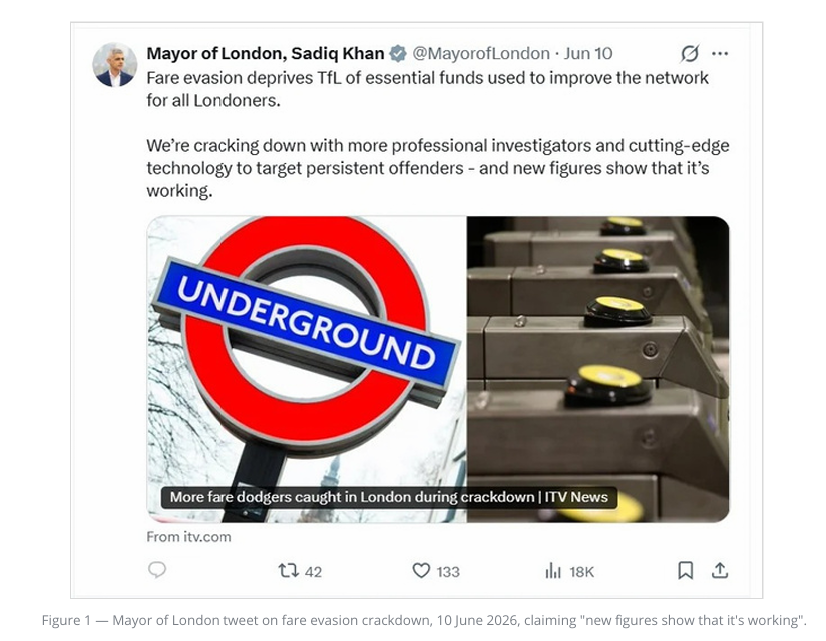
Yet all this information was missing from both the Mayor’s statement and Transport for London’s press release, giving Londoners a false picture that things had improved when they had not. It’s hard to believe this was by accident as TfL holds all this information.
If the headline announcement can be so misleading, what about the blizzard of claims about fines, prosecutions, and numbers of enforcement staff intended to create the impression they’re pulling out all the stops. The Mayor’s claimed crackdown. Was that true?
I recruited the help of the world’s most powerful AI, Claude Fable 5, and went digging. I found TfL data on fare evasion and enforcement going back decades, back through Mayor Khan’s decade, beyond Mayor Johnson to Mayor Livingstone. However, it appears that someone erected an information firewall in 2022: as we emerged from the pandemic, TfL resumed fare enforcement and discovered that evasion had shot up. Fortunately, the prior record can be painstakingly reassembled from historic documents, which is what I have done.
Across the whole network, prosecutions are half what they were before the pandemic, from around 29,000 to around 14,000. London Underground penalty fares have also roughly halved, from around 24,000 to around 13,000. Worse, only about 45% of TfL penalty fares are actually paid, as it turns out the same people who refuse to pay for a ticket also refuse to pay the fine. If the Mayor really is “cracking down”, why not prosecute the people who don’t pay their fine? TfL win 96% of prosecutions as they hold such strong evidence.
Meanwhile, despite repeated claims to be hiring more enforcement staff, the number is the same today as 15 years ago, at around 500 people. The record suggests it has been between 450 and 500 for decades, despite the network growing and getting busier. All the claims to be recruiting enforcement staff seem to be natural turnover, not extra people.
But this is deeper than one or two overly ebullient press releases. The London Assembly Transport Committee investigated fare evasion in July 2025 and when we directly asked for previous data to give context to the new figures, we were flatly told by senior TfL staff that TfL “did not consistently track or measure levels of fare evasion” before 2022/23. Was that true?
There was a change to methodology in 2022, but TfL has not explained what changed or what effect that had on the numbers. Was the new data higher or lower, and by a lot or a little? Across all modes or just one or two? When public authorities change the way important statistics are calculated, it’s good practice to publish both sets of figures for an overlapping period to allow researchers to understand the impact. TfL did not do this, either.
The true picture that emerges is that TfL decided to ignore fare evasion during the pandemic, so it spiralled out of control. Many people noticed this. In the years since, TfL has never regained control, and the fact that fines and prosecutions are running so far behind the pre-pandemic level suggests it has not been a Mayoral priority.
Instead, what I have found is a pattern of exaggerated, misleading, or even false claims combined with a data transparency strategy of making it hard to find the pre-2022 data that exposes the reality.
Perhaps the most important finding is that on numerous occasions in the past, fare evasion has been successfully reduced. When TfL took over the Overground, they reduced its evasion from 12.6% to 1.8% in four years.
From 2005 to 2016, across the whole network it was cut by two-thirds to 1.2%, so Mayor Khan’s “bold” target of 1.5% by 2031 is higher than the level he inherited in 2016. Nevertheless, it has been done before so there’s no reason they can’t repeat that now, but it’s harder to do that when the Mayor’s approach seems to rest on covering up what’s really happening. If the Mayor isn’t moved to transparency, in 2010 a TfL Committee ordered quarterly publication and could do so again.
Therefore, following on from my colleague Thomas Turrell’s report on fare evasion in November 2025 (“Stolen Millions”), this report attempts to penetrate that blizzard with some bright sunlight, and makes recommendations on publishing data that will mean everyone can clearly see what is going on in the hope that we can get back on track. *If a better approach to publication costs slightly more, perhaps some of the £7 million “tackling disinformation” budget could cover the cost. *
So this is a report in two halves. The first half consists of this foreword and section 1 which set out the overall problem then seek to tackle it at source with a plan for Transport for London to publish information routinely in a consistent, comparable fashion, including rates of evasion, action being taken, rate by mode, and performance against their own targets. This is all information that TfL has published in the past.
The second half acts as a repository, bringing together for the first time every piece of data I could find, forming the most comprehensive ever picture of fare evasion across the London transport network. The recommendations are designed to ensure that no one ever has to do this again.
Read the full report Fact Evasion: How the Mayor doubled evasion, halved enforcement, and buried the data.
Download the full report