Since the pandemic, London has been living through a phone-theft epidemic — phones snatched in the street, often by riders on illegally modified e-bikes, faster than at any time on record. In February 2025 I published a report that asked a simple question: if we understand where this crime happens, can we actually stop it? The answer turned out to be yes.
Download the report — Tackling London’s Theft Epidemic (PDF) →
Crime that concentrates
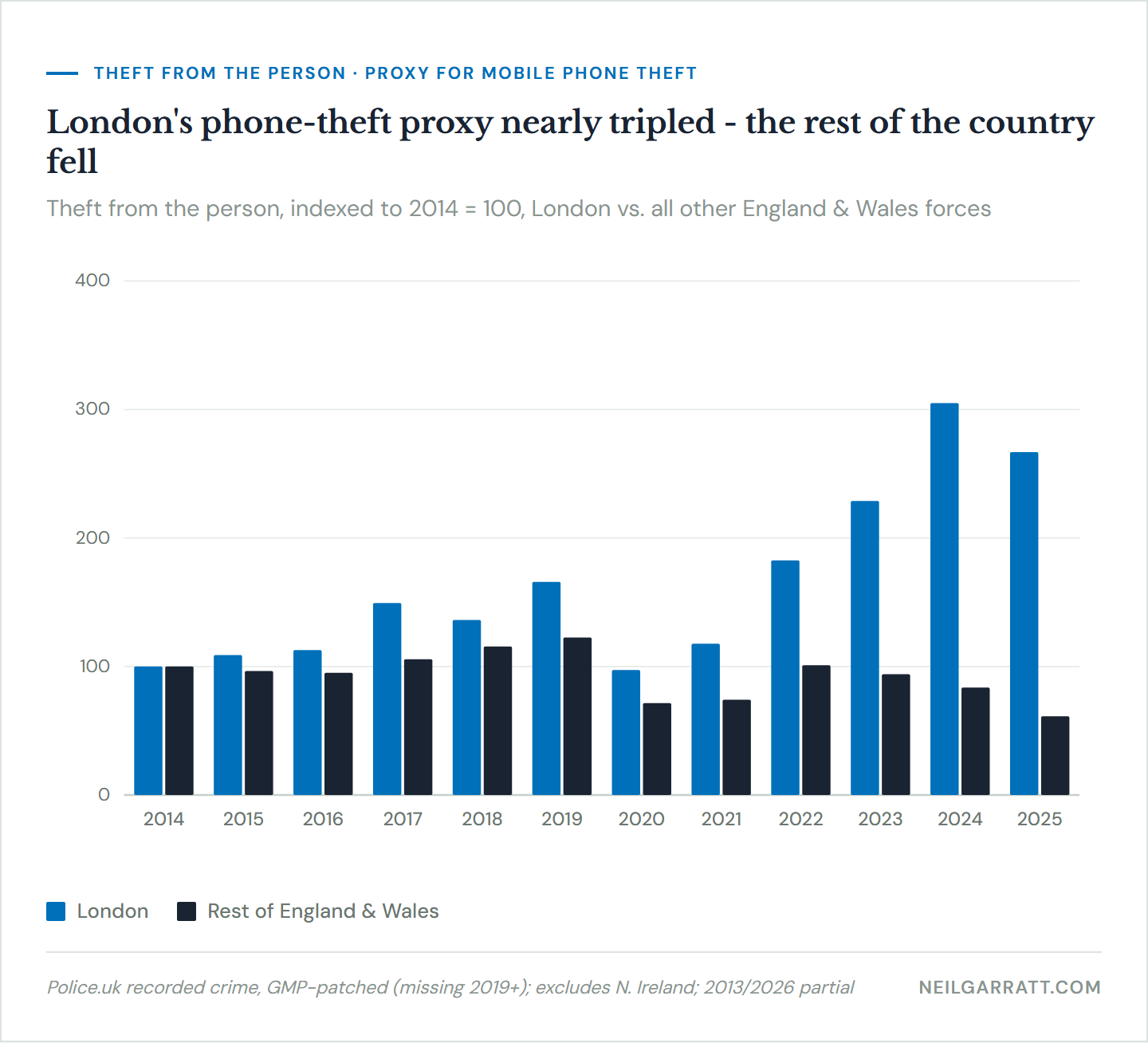
London’s phone-theft epidemic was never a national one. Using Theft From Person as a proxy — most Theft From Person in London is mobile phone theft, and it is the measure published consistently across every force, so it allows a fair national comparison — London’s rate nearly tripled after 2014 while the rest of England and Wales actually fell.
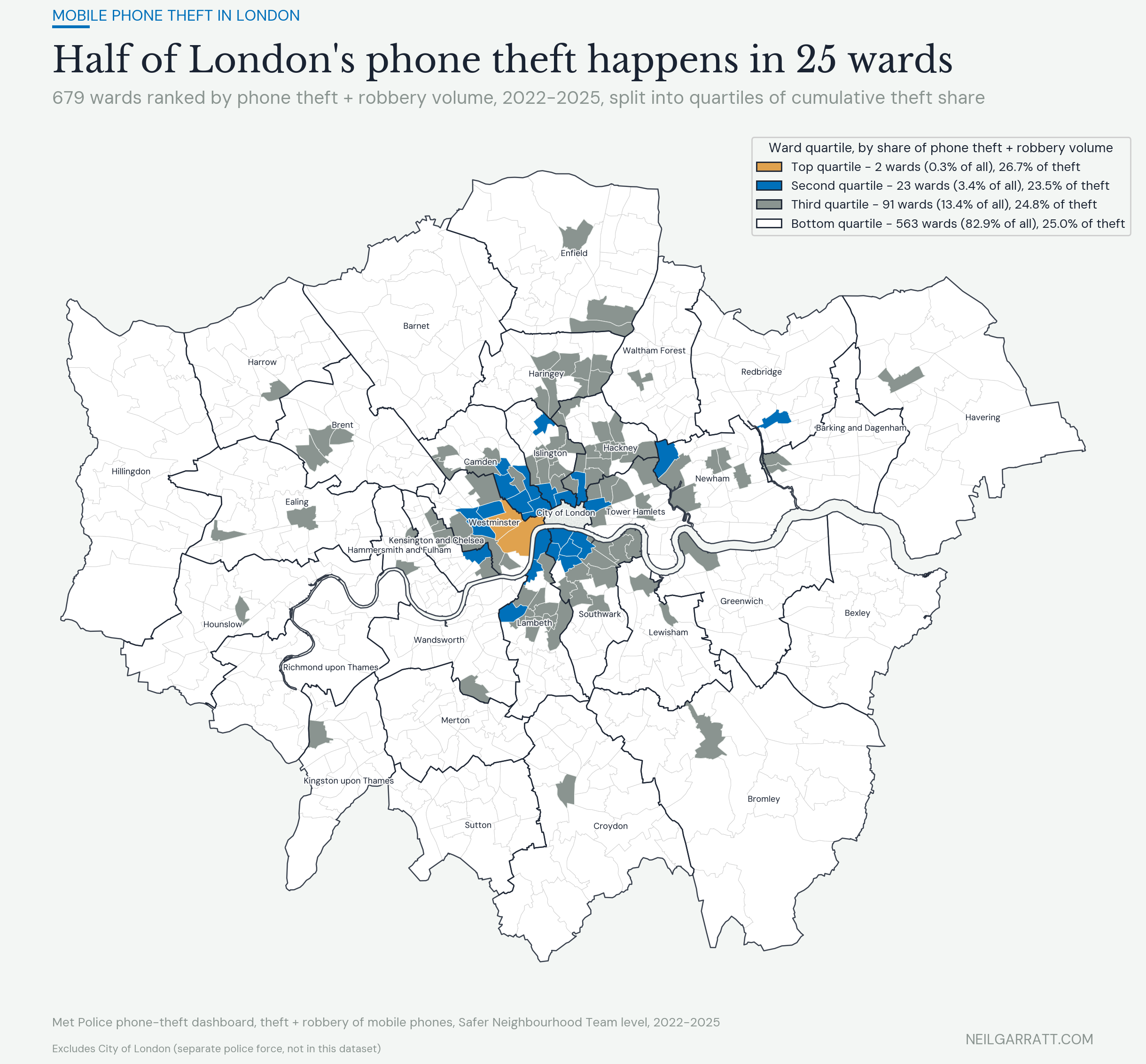
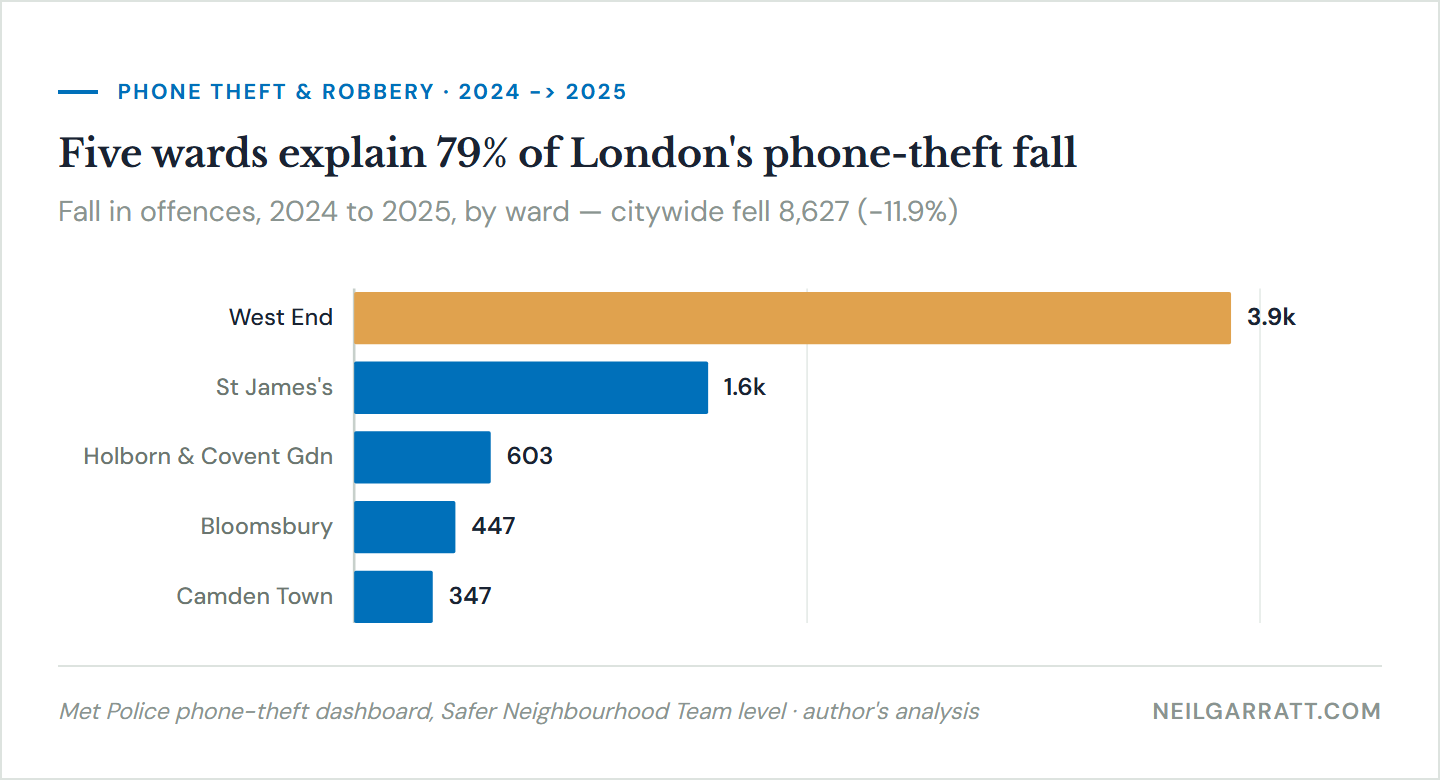
Within London, the concentration is starker still. Rank every ward by phone theft and robbery and half of it happens in around 25 wards. The entire top quartile is just two wards — West End and St James’s, both in Westminster — which between them account for more than a quarter of all phone theft in the capital.
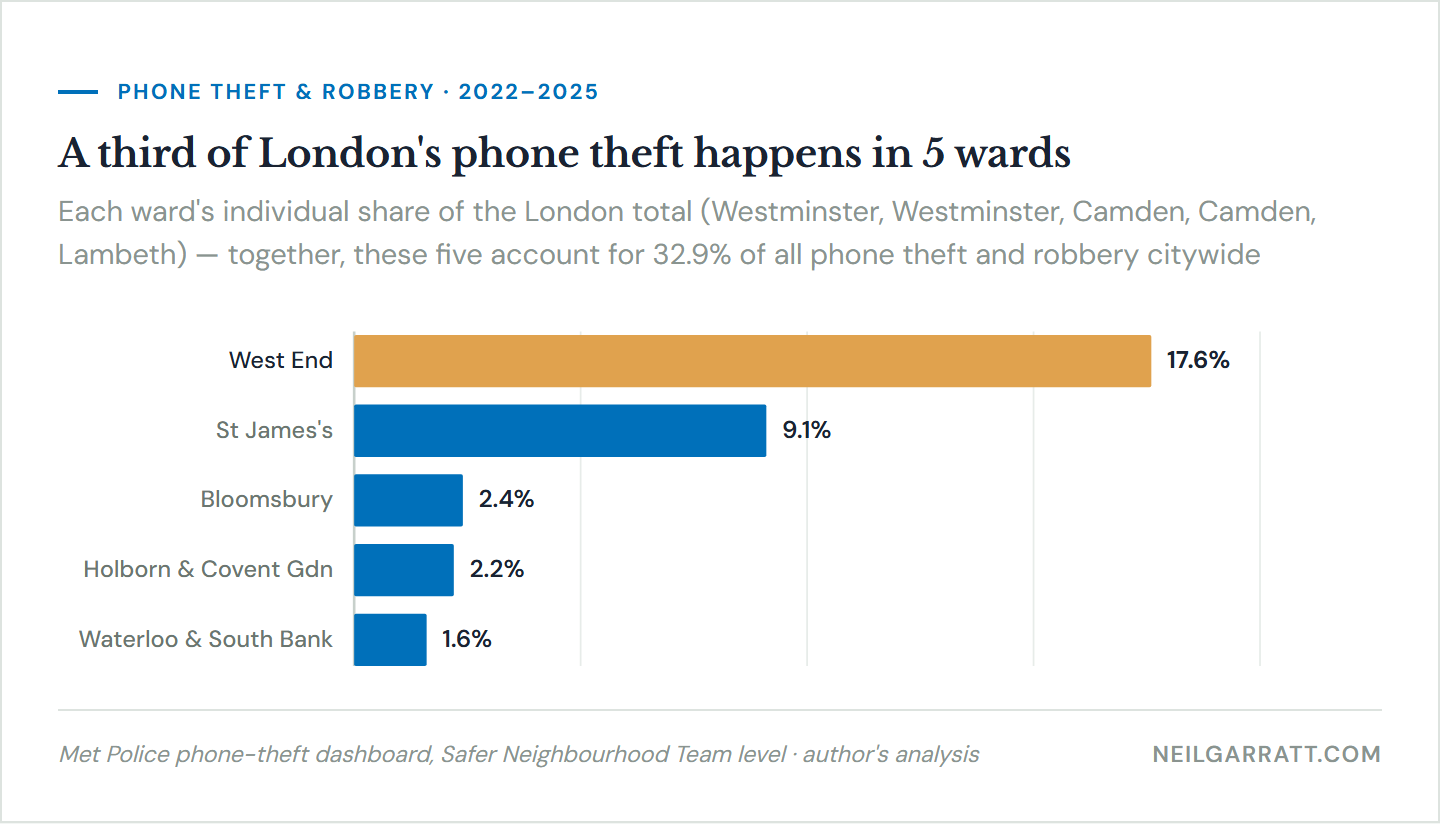
Narrow it to the top five wards and they account for a third of the citywide total, with the West End alone responsible for almost one in five thefts.
This is the concentration of crime effect, and it is the single most important fact for setting policing strategy. When a crime clusters this tightly you do not need to police everywhere at once: concentrate enforcement on the handful of places where the crime actually happens and you get results out of all proportion to the effort. That was the heart of my report — a strategy of targeted, intelligence-led enforcement in the hotspots, backed by a specialist team. I launched it with the Shadow Home Secretary, Chris Philp MP, and Dr Lawrence Newport of Crush Crime.
What happened next
Over the following year, the Met did exactly what the data pointed to. Officers concentrated operations on the worst-affected hotspots — the West End, Waterloo, the South Bank and Borough — and used drones as “eyes in the sky”, plain-clothes teams and Sur-Ron pursuit bikes to run down the snatchers on their illegally modified e-bikes. The Met’s Assistant Commissioner was explicit that neighbourhood policing had been maintained “particularly in the West End” — the very ward my report had flagged as the epicentre.
The result was the first fall in London’s phone theft since the Met began publishing the figures.
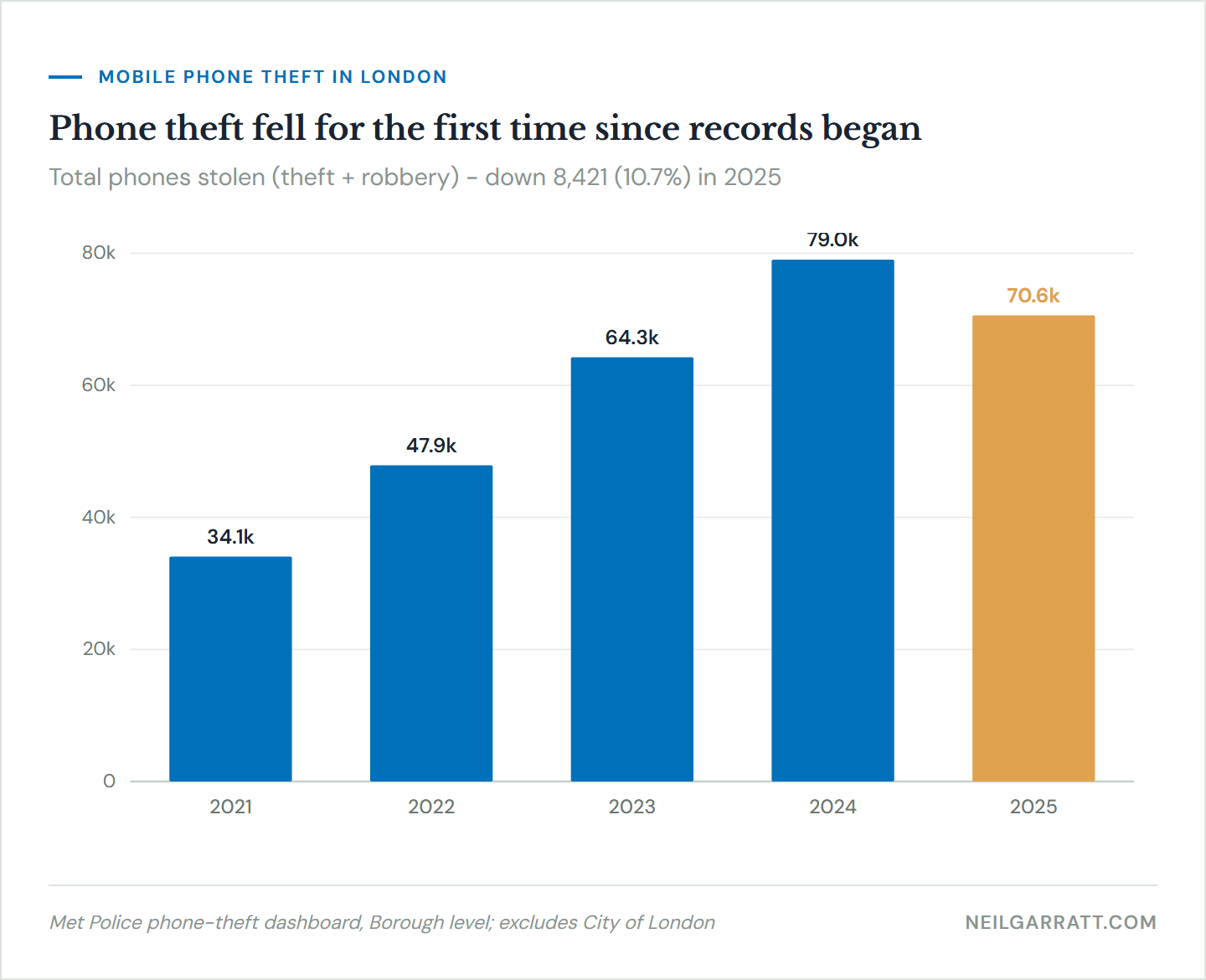
And — exactly as the concentration-of-crime effect predicts — the fall was overwhelmingly driven by the same wards that drove the epidemic. Nearly four in five of the citywide reduction came from just five wards, led once again by the West End. Target the crime where it concentrates, and that is where the crime falls.
The Mayor’s blind spot
None of this came from City Hall. When the Mayor published his draft Police and Crime Plan at the end of 2024, phone theft — by then one of the crimes Londoners worried about most — barely rated a mention, reduced to a single line about phone manufacturers adding a “kill switch”. Bike theft did not appear at all. When I put it to him at Mayor’s Question Time, he had no answer.
A YouGov poll I commissioned in January 2025 confirmed how far City Hall had drifted from the public: Londoners thought phone theft was a serious problem, many had already changed their behaviour because of it, and even Labour voters thought the Mayor was doing too little.
Throughout, neither the Mayor nor his Deputy Mayor for Policing and Crime showed any interest in the concentration-of-crime effect, or in how it could be used to point police resources at the places that would make the biggest difference. Even his belated response now tracks the same map — a new intelligence “command cell” in the West End, the very top of the rankings — though he still reaches first for the phone-makers’ “kill switch”. The strategy worked — but Londoners got the results despite City Hall’s plan, not because of it.